What is SEO: A Beginner’s Guide to Search Engine Optimization

What Is Search Engine Optimization and How Does it Work?
Search engine optimization, commonly referred to as SEO, is the practice of refining content to improve visibility and ranking on search engine results pages (SERPs). To make things simple: the goal of SEO is for your website to show up on the first page of SERPs for relevant keywords – this is what helps your target demographic find you.
SEO now goes beyond traditional search engines. This means you have to show up wherever your target audience might be looking for answers or a product you sell, including Social Media platforms, YouTube, Reddit, and AI-powered search tools. Adobe found that nearly two in three people in the U.S. regularly use Reddit as a search engine. So it’s no surprise that threads from Reddit often appear on Google’s SERPs.
There’s a lot that goes into it, so let’s break down how SEO works and why it’s important for your website.
How Does SEO Work?
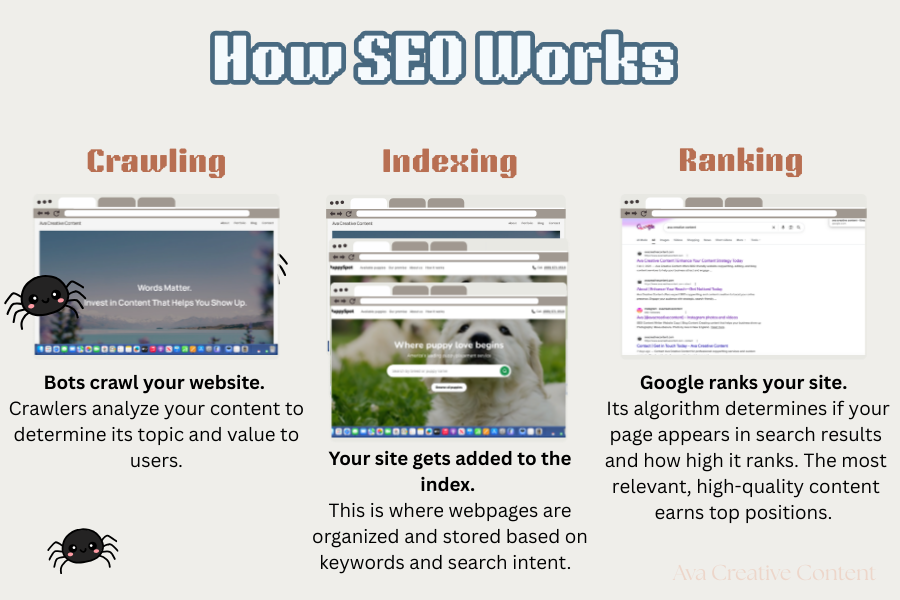
There are three main components to how SEO works. It can feel overwhelming and is always evolving, so let’s go over the basics.
Crawling: How Search Engines Discover Your Website
Crawling in SEO refers to how search engines discover websites and content. This process employs web crawlers, also known as bots or spiders, which follow links between web pages to find new or updated content.
Indexing: How Google Stores Webpages
Once the bots successfully crawl a page, it’s added to the Google index. The Google index is a database of webpages, similar to a library, where text and metadata from each page are stored. This data is structured so that Google can scan it and match it with relevant search queries. This helps you find what you’re looking for when you use search engines.
Ranking: Where Your Website Shows Up
When you type a search query into Google, the algorithm uses keywords to search the index and show you relevant results. If your content is search optimized and has keywords and intent that match a search query, Google will rank it higher in that search, meaning your site is more likely to show up on the first page of results. If you want your site to rank on the first page, making sure it’s crawlable and indexable is essential.
Why Do I Need SEO for my Website?
SEO is essential for making your website discoverable and connecting your business with the right audience online. Optimizing your site and content for search not only helps improve visibility but also enhances the overall user experience of your site. Here are some of the top benefits of search engine optimization:
SEO is a Free Channel: Unlike paid search, where you pay a search engine to promote your site, SEO generates visibility without ongoing ad spend. That makes it one of the most powerful digital-marketing investments out there. However, what’s free financially isn’t necessarily free of time and effort. Effective SEO requires a strategic approach, high-quality content development, and ongoing analysis. If you don’t have the time or expertise to tackle SEO on your own, partnering with an SEO strategist and content writer is a worthwhile investment.
SEO Helps the Right People Find Your Site: People rarely click past the first page of search results, so making sure your site shows up in the top 10 results will ensure that the right people find you. Ensuring your technical SEO and content are optimized to include keywords that your target audience is likely to search for will drive traffic to your site. Having a strategic blog will help you cast a wide net of content that your ideal customers will search, which will lead them to your site and your products or services.
SEO Makes You Money: Increasing traffic to your website is key to driving revenue. SEO helps your products or services rank higher in search results, increasing the likelihood that customers choose you over competitors. If you have a service-based business, increased visibility and traffic to your site are essential for generating leads. Once your customers find your content, it had better be designed to convert, or you could miss out on sales. This is where having an experienced content writer comes in handy.
Paid Search vs. Organic Search: What’s the Difference
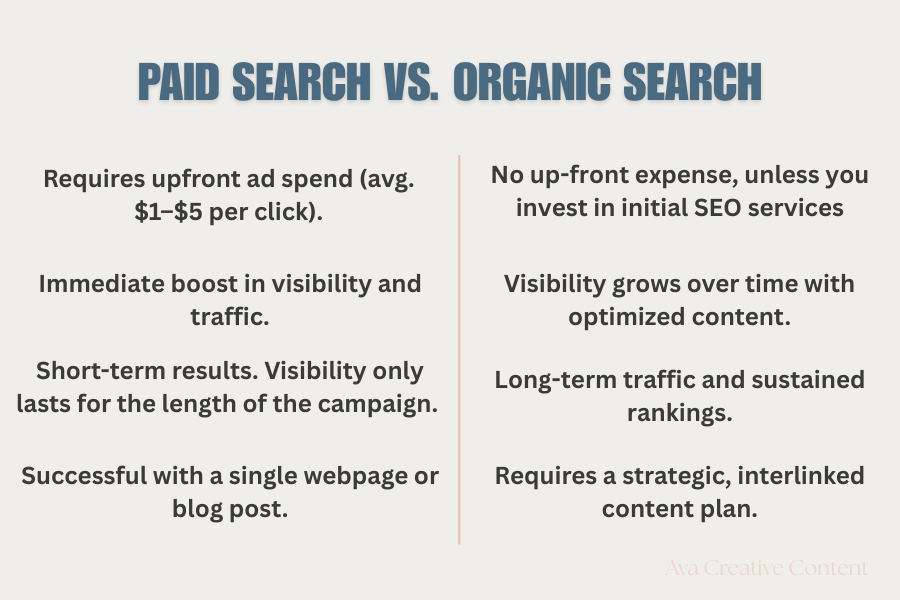
When you type a query into a search engine, you will get two kinds of results. These are referred to as paid search and organic search. In short, these are the two avenues you can take to get your webpages to show up on the first page of search results. Each type of search has its own set of pros and cons.
What is Paid Search?
Paid search is a digital marketing strategy where you pay a search engine to rank your webpages or content higher for specific keywords. Paid content appears at the top of the page or on a side banner and is typically labeled as “sponsored,” which indicates that it is an ad. This strategy immediately increases visibility and can drive a lot of traffic to your site. Paid search is expensive, typically costing you an average of $1–$5 per click. If you invest in paid search, ensure your site is user-friendly and that sales funnels are optimized.
What is Organic Search?
Organic search relies on search engine optimization to boost your site's visibility. Organic search results rank on the first page because they are the most relevant based on keywords and search intent. Unlike paid search, which produces immediate results, it can take a few months to a year for your content to rank well with organic search. However, organic search can pay off big over time. Since organic search is free, companies can see higher ROI from content that continues to generate traffic and sales for months to years after it’s been published. Unlike paid ad campaigns that run for a set amount of time, your SEO optimized web content and blogs can drive consistent traffic to your site for years to come, making SEO services a worthy investment for your business.
What are the Three Pillars of SEO?
On-Page SEO
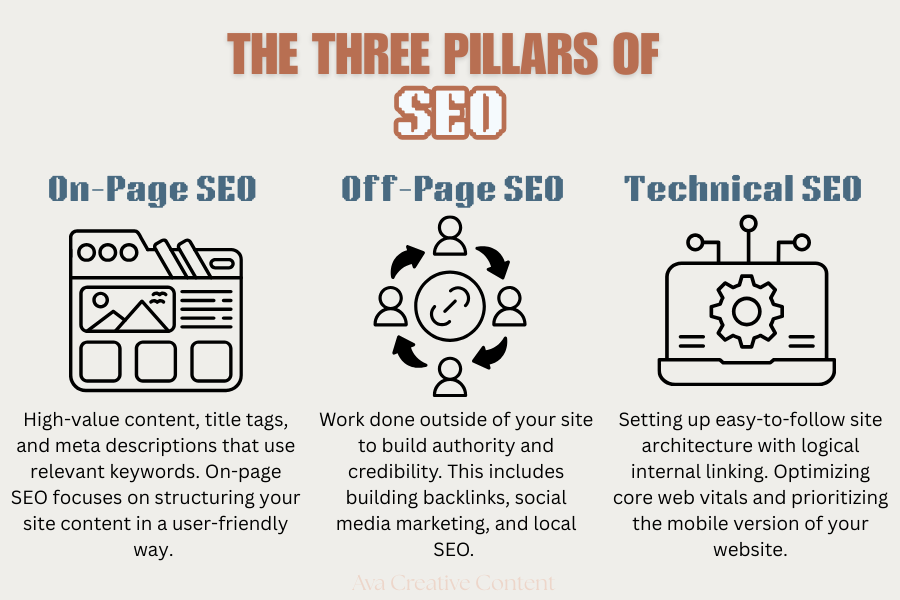
On-page SEO is what you do (you guessed it) on your website to improve your visibility and ranking. This includes using relevant keywords, writing valuable content that matches search intent, optimizing title tags and meta descriptions, structuring pages with clear headings, and adding internal links between related pages on your site. On-page content includes interactive elements, text, images, and videos. You can do a lot of this on your own with some research and the right tools. You may want to hire SEO services like an SEO-savvy web designer and a copywriter (that’s me!) to make sure things are done correctly and to save you time and a headache.
Off-Page SEO
Off-page SEO is what’s done outside of your website that helps you build credibility and authority with Google and results in higher rankings. This can include link building, social media marketing, influencer marketing, and local SEO. Link building involves getting backlinks to your website from other sites. When you get a backlink from a site with a high authority score with Google, it can help boost your authority as well.
Technical SEO
You can have the most valuable content in the world, but if your technical SEO is lacking, it’s not going to rank in organic search. That’s because technical SEO is what makes your website easier to crawl and index, and that’s how content is ranked. Some website builders, such as Squarespace, Wix, and GoDaddy, use AI to do basic SEO for you, like meta tags, site mapping, and mobile optimization. If you have a large website or really want your technical SEO to be on point, you’ll likely want to invest in professional SEO services, at least to get you started.
Here are some (of the many) things that go into technical SEO:
Site Structuring: This involves creating a logical and easy-to-follow site architecture and internal linking. This also includes ensuring there are no broken links or pages that are noindexed when they shouldn't be.
Improving Indexability: This involves removing duplicate content on your site, implementing canonical tags correctly, and removing low-value pages.
Optimizing Site Speed and Core Web Vitals: This includes tasks that improve the user experience of your site. Core web vitals include your web page loading speeds, interactivity, and visual stability, which all contribute to user experience.
Mobile Optimization: Mobile drives over 60% of search, which prompted Google to switch to mobile-first indexing back in 2023. This means Google will index and prioritize the mobile version of your site over the desktop version – so you'd better make sure it’s optimized.
Data Structuring: This involves adding the appropriate schema markup to your site. What is schema markup? This is the code that’s added to your page's HTML that tells crawlers what kind of content is on your site. Users don’t see this code, but it tells search engines whether they’re crawling a recipe, a FAQ section, or a product page, which helps them with their indexing.
Error Monitoring and Maintenance: Once your site's basic technical SEO is in place, you still have to monitor for errors, broken links, broken canonical tags, and orphaned pages. You can identify these errors by conducting a site audit using SEO tools – fixing them as soon as possible will help keep your site visible and running smoothly.
Other Types of SEO
Image SEO
In the same way that websites rank under the “All” tab on Google, images are also ranked based on SEO. Using descriptive file names, proper alt text, and compressing files can help the images on your site drive traffic and boost visibility.
Video SEO
Much like image SEO, this is the practice of optimizing video content to rank higher on search engines and on platforms like YouTube. This includes using relevant keywords in titles, tags, and descriptions, as well as creating valuable, user-friendly video content.
E-commerce SEO
E-commerce SEO involves optimizing online stores to rank higher in SERPs, so when shoppers are looking for a product you carry, they’ll find you before they find your competitors. While this includes regular SEO, there is a focus on enhancing product pages so shoppers can easily find what they’re looking for.
Local SEO
Local SEO is the practice of optimizing a business's online presence to attract local customers in its area. This is especially important for brick-and-mortar businesses or professionals who serve a specific area. This includes optimizing your Google Business Profile and incorporating relevant local keywords on your site. Creating localized blog posts that cover topics catered to a specific geographical area and using relevant local keywords is another way to enhance your local SEO.
Want Help Putting SEO Into Action?
Knowing how SEO works is the first step. The next step is creating optimized blog content and website copy that actually gets found.
If you're ready for content that drives visibility, traffic, and conversions, let’s talk.
Frequently Asked Questions
-
SEO stands for search engine optimization.
-
Yes, basic SEO is necessary for search engines to crawl, index, and rank your site. Adding optimized content with relevant keywords and staying on top of your technical SEO can be a powerful marketing tool that compounds over time, driving traffic to your site and boosting revenue.
-
Any business that has a website needs SEO. Businesses that are linked to a physical store or provide in-person services should also focus on local SEO.
-
No, SEO is not exclusively for websites. Any online content that you want people to find, including social media posts, video content, and business listings, can be optimized for search, as they all can rank on SERPs.
-
SERP stands for search engine results page. It refers to the specific results page displayed by a search engine in response to a specific query. If you search “books about dogs” on Google, the SERP is the page listing the results of your search.